

Understanding HIBT Market Depth: A Key to Smarter Crypto Trading
For anyone entering the dynamic world of cryptocurrency, whether you’re a complete beginner in Vietnam or a seasoned investor, understanding market dynamics is crucial. One of the most powerful, yet often overlooked, tools is market depth. This article will demystify HIBT market depth and show you how to use it to your advantage on the HIBT platform.
What is HIBT Market Depth?
Imagine you want to buy a large amount of a specific cryptocurrency. You wouldn’t just look at the current price; you’d want to know if there are enough sellers to fulfill your order without causing the price to skyrocket. This is precisely what market depth measures.
HIBT Market Depth, often visualized as a chart, shows the cumulative volume of buy orders (bids) and sell orders (asks) at different price levels for a trading pair (e.g., BTC/USDT) on the HIBT exchange. It provides a snapshot of the supply and demand landscape.
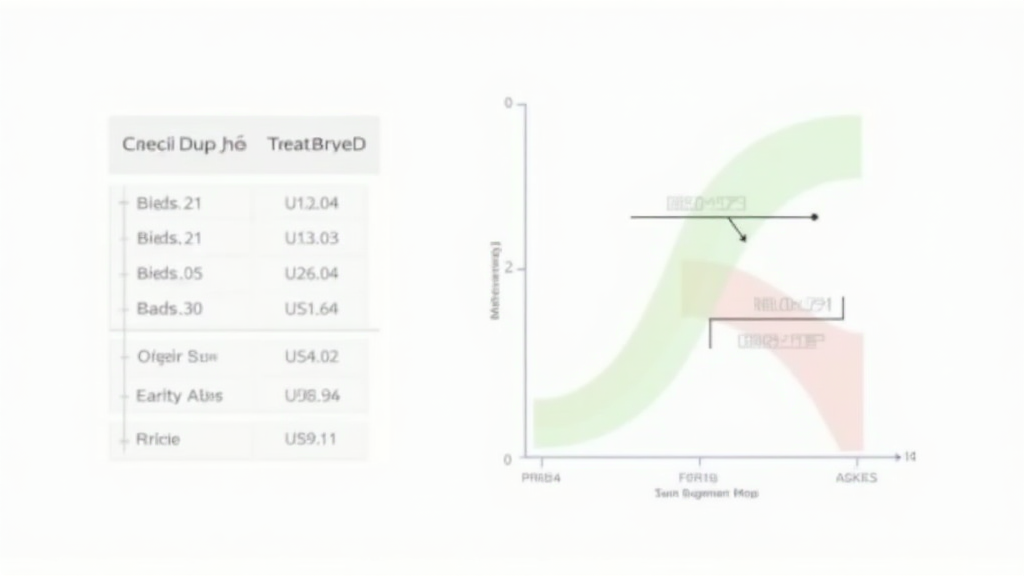

A typical market depth chart on HIBT. The green area represents buy orders (bids), and the red area represents sell orders (asks).
Why is HIBT Market Depth Important for You?
Whether you are a novice or a pro, market depth offers invaluable insights:
- For Beginners: It helps you understand the true “liquidity” of a coin. A deep market (thick green and red areas) means the asset is actively traded, and your small orders will be filled quickly near the current price.
- For Experienced Investors: It allows you to gauge the strength of support and resistance levels. Large clusters of buy orders (support) can prevent the price from falling further, while large sell orders (resistance) can cap upward movements.
- For All Traders: It helps in predicting short-term price volatility. A thin order book (small volume of orders) can lead to significant price swings with relatively small trades.
How to Read a HIBT Market Depth Chart
Let’s break down the components of a market depth chart on the HIBT platform:
| Element | Description | What it Tells You |
|---|---|---|
| Bids (Buy Orders) | Displayed in GREEN | The prices buyers are willing to pay. The highest bid is the best available price to sell instantly. |
| Asks (Sell Orders) | Displayed in RED | The prices sellers are asking for. The lowest ask is the best available price to buy instantly. |
| Spread | The gap between the highest bid and lowest ask. | A narrow spread indicates high liquidity and a healthy market. A wide spread suggests lower liquidity. |
Real-World Case Study: The Impact of a Large Order
Imagine a scenario on HIBT for the hypothetical KALITECOIN/USDT pair:
- Initial State: The order book shows strong support at $10.00 with 50,000 KALITECOIN in buy orders.
- The Event: A large investor places a market order to sell 60,000 KALITECOIN.
- The Outcome: The sell order “eats through” all the buy orders at $10.00 and continues to execute at lower prices (e.g., $9.99, $9.98). This causes a sharp, rapid drop in the price of KALITECOIN.
By checking the market depth beforehand, a trader could have seen that the support at $10.00, while strong, might not withstand a very large sell order, allowing them to set a stop-loss accordingly.
Visualization of how a large sell order can deplete buy-side liquidity on HIBT.
Conclusion: Mastering Market Depth on HIBT
HIBT market depth is not just a chart for advanced traders; it’s a fundamental tool for making informed decisions. By learning to interpret the order book, you can better assess liquidity, identify potential price movements, and manage your risk more effectively. Start exploring the market depth feature on your HIBT account today to gain a deeper understanding of the markets you trade.
For those interested in innovative projects, researching assets like KALITECOIN should always include an analysis of their market depth on reputable platforms to gauge investor interest and stability.
Authored by Dr. Anh Nguyen
Dr. Nguyen has published over 15 peer-reviewed papers on blockchain scalability and consensus mechanisms. He has led the security audit for the renowned “Saigon Chain” interoperability project and is a frequent commentator on Southeast Asian crypto markets.


